A campsite on the coast of eastern Holstein. Toto’s Africa is blaring from the washhouse. A German flag flutters in the wind, birches rustle. A moment ago it was sunny; now the small fleecy clouds are darkening. Children bounce on a giant trampoline – boing, boing. Then, thunder. It smells of tomato sauce burning on a camping stove.
Six adults and a baby are sitting on folding chairs next to the playground. Their cars are parked beside them in rows: there are vans with mattresses and tents. Myriam Spicka comes racing over from her black Land Rover, six bottles of alcohol-free beer in one hand, a huge saucepan in the other. “Dockside beer,” she calls to the group of recreational divers. This weekend, they are being trained for their work in the seagrass meadows. Everyone is here for the same reason: to do something for the environment. First there will be theory, then diving.
Spicka’s reddish-blond hair under her North Face cap has been bleached by salt water and sun. She is wearing socks in her trekking shoes and a leather cord with a shell around her neck. Spicka is on the board of Seagrass Conservation, the association organising the diving operation. She collects papers: diving licences, medical fitness certificates, proof of insurance. A Bavarian in climbing shoes has not dived for a good 20 years. A biology student from Kiel pulls out her newly issued diving certificate. The baby’s barefoot father has more than 1,000 dives behind him.
It starts to drizzle. At last Ralf Duckheim, Spicka’s co-leader for the weekend, appears. For years he has been fishing ghost nets out of the sea. After a dive in Croatia in 2024, he and Spicka founded Seagrass Conservation with other divers. Their aim is to help seagrass bloom again, powered by citizen science. Because the grass cannot do it alone. It needs volunteers who study and replant it in cooperation with researchers. For this purpose, Geomar Helmholtz Centre for Ocean Research Kiel, together with the Bremen-based marine conservation organisation Sea Shepherd, trains recreational divers such as Spicka to become seagrass experts. They then pass on their skills, so volunteers can provide what research needs: new data.
More than 50 people have joined Seagrass Conservation so far. The only requirements are a diving licence and a health certificate. Today the group includes biologists, a pharmacist, an electrician from Berlin and a teenager with his girlfriend, who will stay on land. “We’re all amateurs: we take it seriously, but we also have fun,” says Spicka, an architect by profession. A pot of spaghetti steams on the camping table. The workshop on the green beneath the sea can begin.
Spicka opens her laptop and starts talking. About Zostera marina, common eelgrass, and its importance for the aquatic ecosystem, for example as a nursery for fish. About its biology, which is not so different from the meadow grass the group is currently chewing their spaghetti on. And about its condition today: mowned down. Over the past hundred years, around 60 percent has disappeared from the Baltic Sea.
Spicka’s story sounds like a dark fairy tale: how, 100 years ago, a slime mould swept away the green carpet on the deep seabed. And how, 70 years ago, the algae bloomed because people washed fertiliser from their fields and heavy metals from their factories into the sea. How the sparse underwater meadows strain towards the sunlight they need for photosynthesis, which today usually penetrates only three metres into the sea. How marine life disappears along with the seagrass: pipefish and cod, for instance. How coasts erode without the wave protection of seagrass meadows. And how the treasure chest on the seabed is slowly releasing the carbon it has stored for thousands of years. And now? “We need to get everyone on board,” says Spicka. “Farmers, anglers, policymakers. And we need to train volunteers to become seagrass experts.” That is why she is sitting here on a cool Friday evening on the Baltic coast.
A tall, bearded man in a muscle shirt with tattooed arms appears. “What are you doing?” “Collecting data on seagrass,” she says. The big man nods. It’s terrible how much seagrass is disappearing here. He is a diver too. Spicka invites him to join in. He fetches a chair from his permanent campsite pitch and sits down with them. A coastline is tattooed on his arms. Germany’s coastline is 1,585 kilometres long. Anyone who wants to stabilise it with seagrass faces calculations at least as long.
Planting one hectare of seagrass by hand costs roughly 100,000 euros, according to Geomar’s calculations. The institute has been part of the SeaStore project to restore seagrass meadows for six years, funded with more than six million euros from the federal government until 2027. At four sites in the Baltic Sea, 1,000 square metres each have been planted for research purposes – that’s about half a football pitch.
Spicka waves this away. It is not just about collecting square metres. It is above all about research, about understanding. Because seagrass in the Baltic Sea still poses many riddles. Where does it grow best? Which species thrive? Is it better to sow or plant? Only 20 per cent of the Baltic Sea’s seagrass meadows have been mapped. In SeaStore, researchers are asking these questions, supported by many hands that transplant seedling after seedling along the Baltic coast, note coordinates, and measure water temperature and wind, year after year.
By the light of their smartphones, Duckheim and Spicka check weather apps. Wind force four. It must not get any stronger, or the sea will be too rough to anchor the delicate seedlings in the seabed. If the wind picks up further, there will only be a trial planting in Lübeck Bay for practice. Zips rattle on sleeping bags. Lightning streaks across the Baltic Sea. During the night, heavy raindrops drum on the tents.
Saturday morning, 8 am. A cucumber and a carton of oat milk peek out of a cooler box. The teenagers make themselves breakfast rolls. More divers have arrived early in the morning; 20 people are now ready. Spicka stares at the white dots on her screen: strong wind over Hohwacht Bay. That means diving in Lübeck Bay, a 30-minute drive from here. Less wind, but also less seagrass.
“Who dives CCR?” Duckheim calls a little later across a sandy car park, the Baltic Sea behind him. CCR diving equipment costs as much as a used small car, but recycled breathing air makes long dives possible. The biology student from Kiel takes a compressed-air cylinder from her car. The sea is 14 degrees. The group will be underwater twice, for an hour each time. Spicka is still exchanging paperwork with a local public-order official; permits from three authorities are needed for them to study the seagrass here.
The divers stand in a circle. Spicka and Duckheim, wearing red association caps, spread out the equipment: a square plastic frame, a small spade, a yellow bag for the seagrass, a tape measure, a kind of giant corkscrew to hold the lines on the seabed, and a double-ended carabiner so everything does not drift away underwater.
Act one: practising taking samples. Rolling out the tape measure on the meadow next to the car park: the transect. Counting blades of grass to the left and right of it. Spicka puts down the counting quadrat, divided into four smaller squares. If at least five shoots can be seen in the small square, the donor meadow is healthy enough to take fragments for planting. A maximum of two percent of a meadow is allowed.
The divers stand on the grass in seven groups of three. Some lose count. What counts as one individual grass plant anyway? “Only the shoots,” Spicka calls. Later, underwater, the result will be passed on by hand signal to one diver in the three-person team and recorded in a waterproof logbook, the Wetnotes. The biology student mimes putting the green spade into the ground. Spicka rushes in: “Careful, we want to loosen the rhizome, not execute the roots.” Gently, the imaginary shoot moves into the yellow belly pouch. “It’s like gardening, just underwater,” says the biology student.
Act two: into the water. Every step has to be right now. The Bavarian checks breathing-gas mixtures, the biology student her dive suit. Duckheim goes around helping wherever something is not quite right. Spicka briefs the group: emergency oxygen is on the roof of her car. The electrician from Berlin and the teenager are already standing ankle-deep in the Baltic Sea, fins in their hands, cylinders on their backs. They are to lay out the tape measure at a spot the training team marked earlier, 500 metres from shore. The electrician is a technical diver. He has learned to perform complicated tasks underwater, such as anchoring a tape measure in hard ground. Sand swirls up, clouding the view. Then, at last, it is in place. The teenager notes the coordinates as well as he can in the watery murk. After an hour, both surface again and signal to the others: everything is ready.
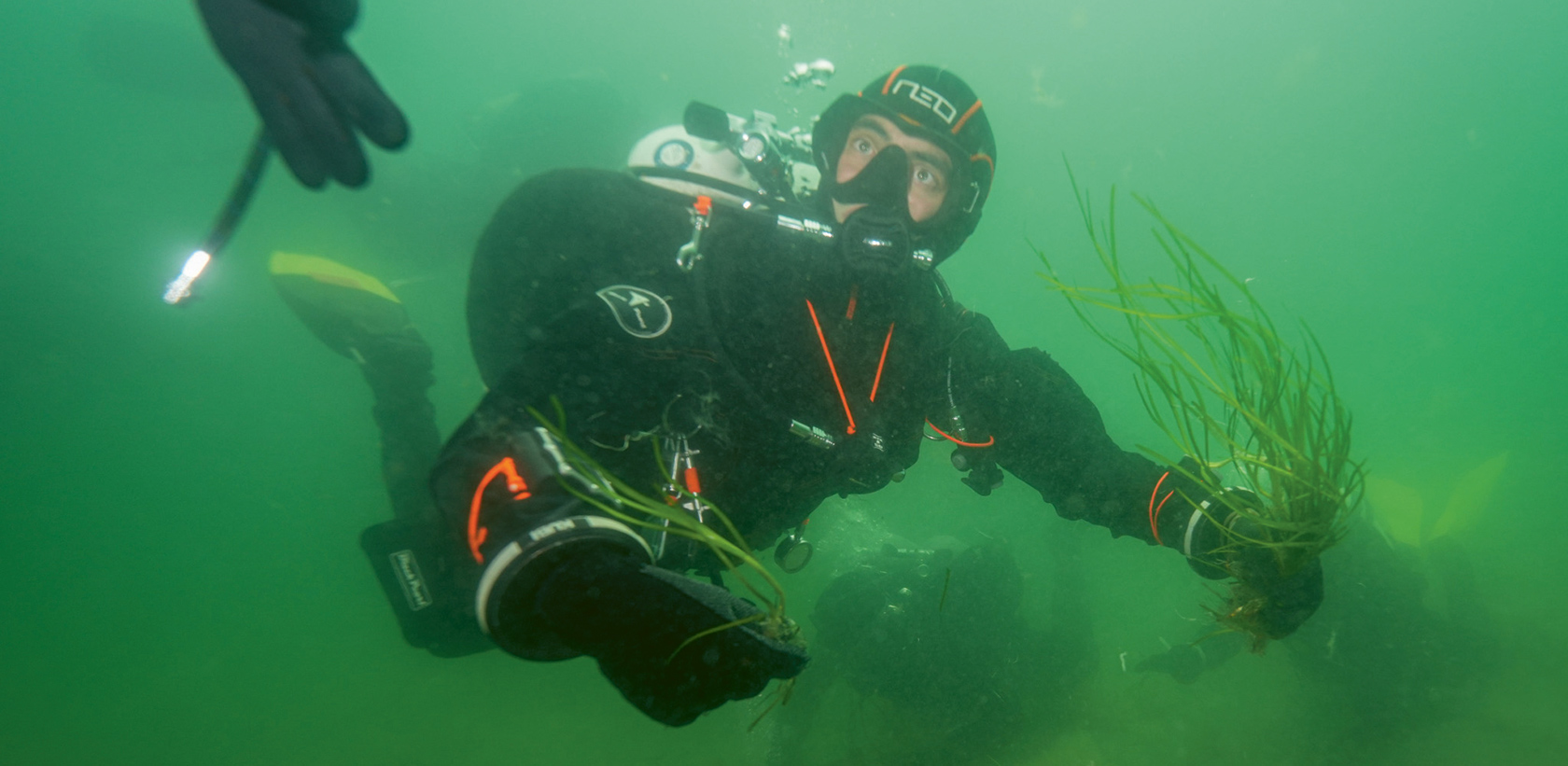
The divers wade into the water in pairs, one hood disappearing after another. Three metres below the surface, the groups of three float belly-down in a circle, as if skydiving. The red counting quadrats glow in the underwater green. The seagrass shoots sway in the swell; counting them is like reading while drunk: top and bottom blur into one another. The spade bounces off the hard sediment. With gloves on, lifting a shoot and its delicate roots from the ground undamaged is tricky. The dive lasts 64 minutes. The biology student’s lips are blue. ‘I didn’t think digging them out would be this hard.’ From the yellow belly pouches, the seagrass plants are moved as quickly as possible into the camping box filled with seawater at 14 degrees. Seagrasses are sensitive to temperature changes.
With steaming thermos flasks, the group finally gathers for the last act: the grass must be sorted by sexual characteristics. It carries both male and female floral organs on the same plant. The male flowers produce pollen; the female ones are pollinated and then form seeds. The female ones will soon be released to drift freely in the sea, while the male flowers will be planted in the sediment today.
Seagrass Conservation carries out four planting operations like this each year. But planting seagrass also means wading into legal murk. Permits are currently issued only on a provisional basis – a legal grey area. The biggest hurdle for larger seagrass planting operations is, in essence, a single sentence in the permit from the Waterways and Shipping Authority (WSA): a contract still has to be concluded with the Federal Republic of Germany for the use of the seabed. Fish farms, for example, have to pay six-figure sums to use an area of 1,000 square metres. An association such as Seagrass Conservation could never afford that. All initiatives are waiting for a fundamental decision from Berlin: should actions for environmental protection and science be treated the same as commercial use? Spicka and her group carry on regardless. They are tolerated, and that is enough. In 2025, only a few square metres of seagrass were planted. At one site, 10 percent survived the winter; at another, 70 percent. For Spicka, that is not failure, but data.
Once all the plants have been sorted, the gardeners wade back into the sea, carrying eight bundles of seagrass in yellow bags. Today they are planting 160 seedlings. In a few weeks, Spicka will check on them. Then in a year. And the year after that. When she resurfaces after 61 minutes, the sun is shining on her face. “Underwater, everything is simpler. More beautiful.”
_________________
This text was translated by our partner kompreno — created with the support of various AI models, then reviewed and refined by their editorial team. kompreno curates the world’s best journalism from over 30 international outlets — including The Atlantic, Le Monde and Die Zeit — and makes it available in five languages.