The small motor dinghy races through Palma Bay as if it were about to take off. Spray splashes over the bow; Marcial Bardolet Richter stands relaxed in the wind, one hand on the cabin, looking at the white specks along the coastline grow larger: sailing boats, catamarans, yachts. Cormorants screech in the sky, muffled beats thud over from a day cruiser, passengers jump into the water for a morning swim. Bardolet Richter narrows his eyes and points to a bulky catamaran a few hundred metres ahead; beside it, the sea is almost black. “Over there – let’s take a look at that one. It might be anchored in the seagrass meadows.” Juan García Dorronzoro, the captain, changes course. The harbour walls disappear from view, the rumble of port activities fades, and in the distance Palma’s Cathedral dozes in the morning sun. Bardolet Richter opens a map on his phone. Pink dots mark the boats anchored off the coast; some lie close to bright green patches – Posidonia, the Mediterranean seagrass. Like the white catamaran?
“Hello, we’re from the Posidonia Monitoring Service. Anchoring in the seagrass meadows is banned in Mallorca because it destroys them,” Bardolet Richter calls over to the skipper, who is leaning casually over the railing. “According to our map, you’re right on the boundary. I’ll just check quickly, okay?” The skipper nods. The passengers on their sun loungers sit up, sip their drinks and watch. Bardolet Richter hoists an orange underwater viewing scope over the edge of the dinghy and presses its glass eye into the water. The view of the seabed is crystal clear; the grass sways gently in the current. Anchor and chain are lying just beside it. “All good,” he calls. “But if the wind turns, you’ll need to keep a little more distance.” “All right,” says the skipper. “And download our map app Donia. It shows where boats are allowed to anchor.” The boat flies on across the sea.
The second-largest plant in the world
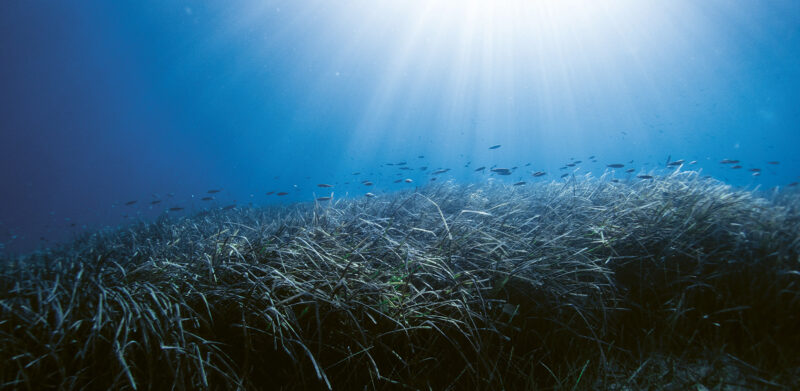
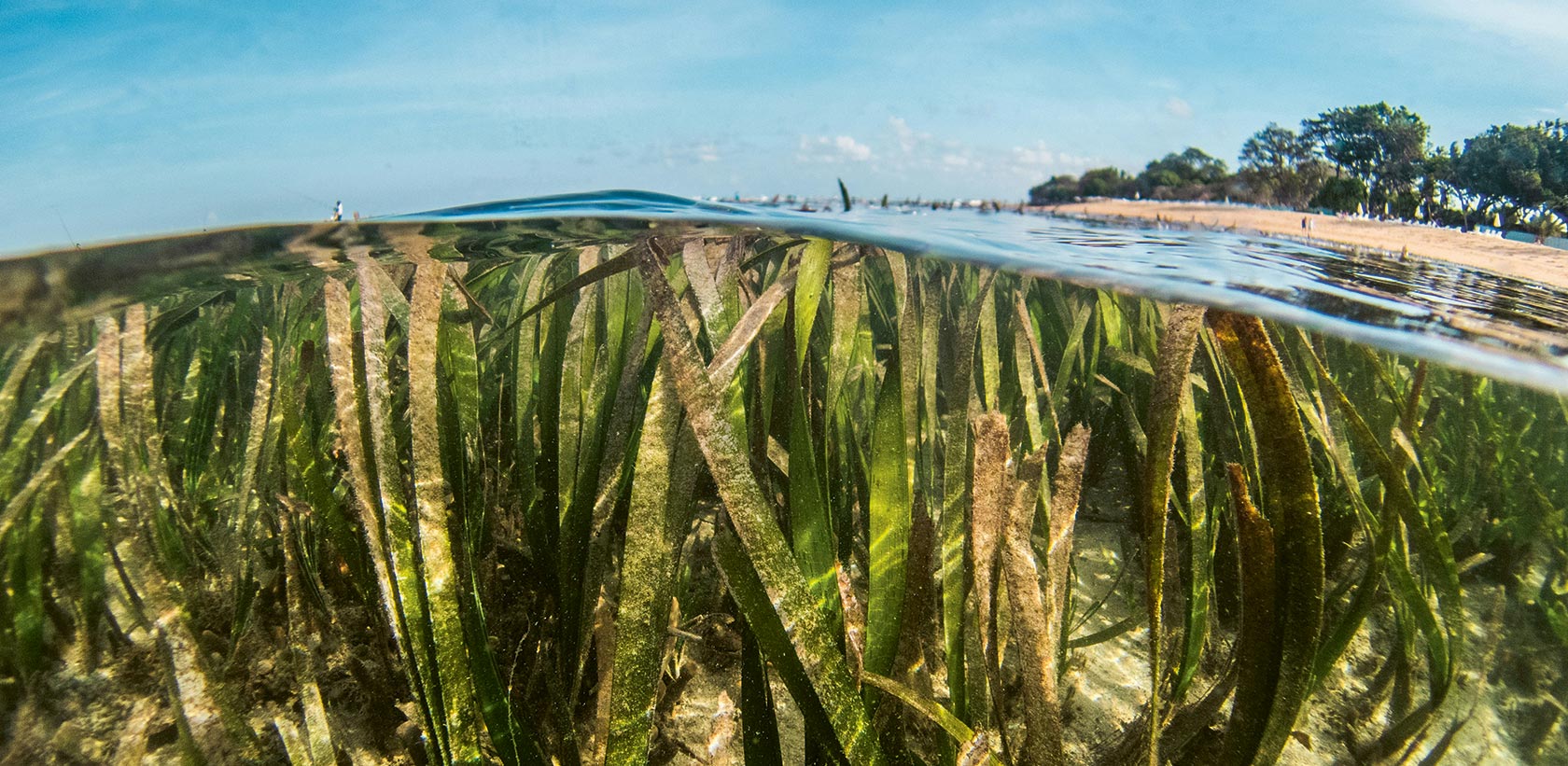
Posidonia oceanica is Mallorca’s greatest treasure. This seagrass, with its metre-long leaves lining the coasts of the islands, is a hotspot of biodiversity and fish life in the Balearics. It supplies the sea with oxygen, prevents coastal erosion with its roots and, according to a recent study, stores one million tonnes of CO₂ in the seabed. That is more than any other ecosystem in Spain, including wetlands and peatlands. Without these meadows, the islands would have neither the clear water nor the fine white sand that make them so popular. They filter the water and provide a habitat for millions of living creatures that break down the rock along the coast. The underwater meadows of the Balearic Islands are among the oldest on the planet; they are thought to be up to 100,000 years old. Between Formentera and Ibiza grows the second-largest plant in the world, around 15 kilometres long. In 1999, the meadow was declared a UNESCO World Heritage Site.
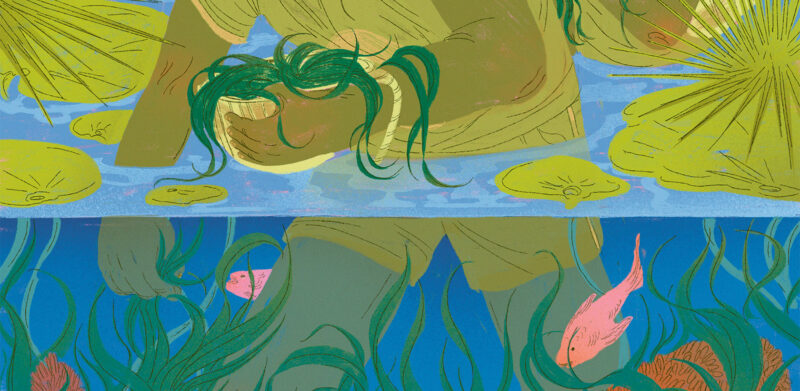
In the past, people were aware of this treasure. In autumn, when the sea washed the meadow leaves onto the beaches, they used them to protect fields from drying out, thatch roofs, and weave baskets. They also used leaves to pad packaging for valuable glassware and cover sunburnt skin to soothe it with their antibacterial properties. They called the seagrasses Posidonia, after Poseidon, the god of the sea in Greek mythology (editor’s note: in German they are also referred to as Neptune grass, after the Roman god of the sea). These meadows, with their broad, smooth blades, were a source of pride; they exist only in the Mediterranean region.
But with industrialisation, this knowledge was lost. Huge hotel complexes lined the coasts, fishers dragged heavy traps through the species-rich meadows, harbour basins were dredged deeper, for more and more ships, ever larger ships. Mass tourism and water sports boomed, and to this day, much wastewater still reaches the sea unfiltered. People now called Posidonia dismissively “algae”, as if it were the slimy seaweed in the water. Today, around 50 per cent of the Posidonia meadows in the Mediterranean region have been destroyed.
The wildest days of the year
Ten o’clock on a Thursday in late May at the Nautic Club restaurant in Portixol, a small harbour near Palma. On the quay, a sailor is repairing the hull of his boat, and fishers are hauling nets from the deck, while tourists stroll past. Marcial Bardolet Richter – canvas shoes, khaki shirt, boyish laugh – comes springing over and drops into one of the terrace chairs. “Phew, these are the wildest days of the year.” The water-sports season is beginning, summer tourism is washing over the Balearics. For Bardolet Richter, that means a lot of administrative work, coordination with shipping companies, boat clubs and environmental agencies. Perhaps a hundred boats are off the coast today; some have room for just four people, others are as big as an apartment block. In July and August, there are more than 30,000 boats with long-term berths, plus thousands more stopping in the Balearics on a cruise through the Mediterranean. “Then anchorages outside the meadows become scarce,” says Bardolet Richter, taking a quick sip of espresso. “Most people want to anchor close to the coast. The open sea frightens especially recreational boaters.”
Marcial Bardolet Richter has been patrolling seagrass for eight years. He is, if you like, something like Mallorca’s chief parking warden; others call him the King of Posidonia. Since the geographer joined the administration in the early 2000s, he has thrown himself into seagrass protection like almost no one else. At that time, science was only beginning to discover the value of seagrass meadows. The impetus came from the EU in 2001: through the LIFE programme for the environment, nature conservation and climate policy, funding flowed into seagrass research. What role do the meadows play as CO₂ sinks? How important are they for biodiversity? How can they be mapped and restored? Researchers from the Imedea marine research institute spread out; over the years, four research stations grew to seventy. Activists began to look more closely. The image of a superyacht destroying 10,000 square metres of meadow with its anchor went viral. Posidonia became a political issue.
A rebel within the administration
Bardolet Richter plays a leading role in this movement within the administration. He developed a map of the meadows around the islands using sonar and satellite data. He pushed forward a monitoring system for protecting them, which is now considered the best in the Mediterranean. “I’m the rebel within the administration,” he says, grinning a little. He is someone who prefers solutions to rules. In 2018, Mallorca became the first island in the Mediterranean to ban anchoring in seagrass.
From May to October, Bardolet Richter and his colleagues are now on duty. In the high season, 18 boats patrol seven days a week. That is when the 51-year-old slips into the green polo shirt bearing the words “Government of the Balearic Islands” – “it gives me authority” – steers through the forest of yachts, plunges his underwater viewing scope into the blue up to 200 times a day and explains to boaters what is at stake: that an anchor can tear out thirty or forty clumps of seagrass, and that the heavy anchor chains carve deep furrows into the seabed vegetation. That Posidonia grows by an average of only two to four centimetres a year, and that a meadow often takes 100 years to recover.
“Many people lack Posidonia literacy,” says Bardolet Richter. Sometimes he uses his dinghy to drive 120-metre ships out of seagrass areas. “But in fact, the large yachts are less of a problem. Rich people want peace and quiet; their teams are meticulous about not giving anyone a reason to disturb them.” More problematic, he says, are occasional and recreational boaters looking for a quick thrill. Some get angry; then Bardolet Richter calls the environmental police. Only they can impose fines for illegal anchoring in the meadows. Usually these range from 500 to 5,000 euros. If serious damage is caused, boat owners may be fined up to 600,000 euros.
But where are all these boats supposed to anchor if there is not enough space away from the seagrass?
At sea parking meters. From early June, eight eco-mooring fields are set up in particularly sought-after coastal sections: huge areas full of buoys, fixed to the seabed with environmentally friendly systems. Boats can moor there without destroying the grass beneath. There are tickets for half days, full days and overnight stays, booked through an online platform. A day pass costs between 10 and 108 euros, depending on the size of the boat and the buoy it needs. It takes four to eight weeks for all the parking meters to be set up. There are currently 311; by 2030 there are supposed to be 1,000. The buoy fields are financed through parking fees and an environmental tax on tourists. Demand is huge; in July and August, the fields are used at up to 130 per cent of capacity.
Three summers of anger
Bardolet Richter still remembers the anger of the first years. Banning anchoring? Where, if not at sea, is freedom as natural as breathing? Where, if not in Mallorca, are immaculate beaches, free of seagrass leaves, such an essential magnet for tourism? In the “three summers of anger” after 2017, he received protest emails almost every day from tourism associations, boating clubs and sailors. It is not that Marcial Bardolet Richter could not understand the anger. He grew up in the Bay of Calle Blava near Palma; at eleven, he had his first small dinghy, a red Optimist. At sea, he dreamed himself into the blue world of Jean-Marc Barr, the freediver in the French cult film The Big Blue. “I also found seagrass nasty and dark.” Only over the years did his view change. When he went swimming in Calle Blava, he found himself asking more and more often: what does it actually look like in the meadows beneath me? One day, he dived down. “And I saw the beautiful queen of our sea.”
Perhaps it is precisely this understanding of different perspectives that has enabled Bardolet Richter to bring more and more people to his side. The left-wing government of the time, which wanted to advance nature conservation. The tourism industry, which was slowly discovering sustainability. Preventing destruction instead of spending millions on uncertain restoration efforts – that convinced many. “By now, almost everyone is on board,” says Bardolet Richter. Since 2017, the number of boats anchoring in the meadows has fallen from 20 per cent to 5 per cent.
Today, the Balearic Islands are regarded as a beacon of Mediterranean seagrass-meadow protection. Forty per cent of the waters are under conservation protection, and many different players are involved: start-ups, NGOs, local forums, citizen initiatives. A whole network has emerged to campaign for the seagrass meadows. In cooperation with the Imedea marine research institute, initiatives, foundations and associations are collecting data for science and testing replanting: how are the meadows faring? What affects their health? How can we bring them back to life? MedGardens was among the first.
Formentor, far to the north of Mallorca. Fine sand tickles between the toes, a breeze moves through the branches of the pines along the shore. Now and then, the laughter of bathers drifts over from the beach of Pollença further west. Laura Royo Marí, Paula Bonet Melià and Lucian Fernández Slade climb into their wetsuits. They pick up diving masks, snorkels, and clipboards with waterproof paper and square plastic frames, their grids divided into smaller squares. “This way we can precisely compare all the data we collect along the coast,” explains Royo Marí. What grows in one square, how does each species reproduce, how have the organisms developed since the last data collection, which animals live in the habitat? Masks on, thumbs up, off they go.
For six years, the oceanographer Laura Royo Marí has been with MedGardens, the scientific arm of the Clean Wave Foundation. It began in 2017 as an initiative set up by friends who wanted to do something about plastic waste in the sea. Today, it has become a foundation with ten employees, committed to healthy seas, more environmental education and, above all, the restoration of marine habitats such as seagrass meadows. At three sites on Mallorca, in close cooperation with the Imedea marine research institute, they study where seagrass meadows are already damaged, what caused the damage, what can be done about it, which methods can restore them most effectively, and which sites are best suited. Especially from May to July, the teams are out in the field three or four times a week. “In June, when the meadows are flowering, we focus on Posidonia. Today, we’re looking at the development of the alga Cystoseira, which coexists with the seagrass in shallow bays,” explains Royo Marí. “We planted some three years ago.” What has become of them?
Into the water with the stone belt
Jet skis thunder past, motorboats pass by. Royo Marí swims to the small island opposite the shore and straps on a stone belt. A stone belt? She laughs, tucks the underwater notepad under her arm and adjusts the diving mask over her neoprene hood. “It keeps me stable in the shallow water while I’m counting fish.” She clamly dives under, body stretched out, head first, and with a quick hand notes how many fish are swimming through meadows and algae. Paula Bonet Melià has unrolled a rope along the shore, with coloured markings every 20 centimetres. At each mark she holds her frame over the seabed, counts plants, living creatures and shoots square by square, and calls the result to Fernández Slade, who is sitting on the beach with a clipboard full of tables. “Paula needs both hands when she’s counting plants.”
Research close to people
Science is painstaking work. Meticulous, repetitive, slow. And yet it is precisely the field research that drew all three of them to MedGardens. Research in the real world, close to people, with the power to really change something, because their data fills gaps in scientific knowledge. For example, when it comes to planting Posidonia only where it already thrived before, the MedGardens team’s surveys helped establish this insight. The work also includes education in schools; Royo Marí develops concepts for workshops. There is cooperation with local communities, which biologist Paula Bonet Melià is driving forward. There are partnerships with funders and the tourism industry, which economist Lucian Fernández Slade is expanding.
“Come with me, there are very healthy meadows back there. You have to feel them to understand them.” Royo Marí holds out her hand. The water closes over our heads; through the diving mask, the view opens onto a world that is not dark but flickering with light. Sunlight breaks in the water; points of light dance through the green like crystals, and a rust-red starfish sunbathes in the shelter of the meadows. The long hair of the Posidonia rocks gently in the sea current, sometimes light green like buds on a tree, sometimes honey-gold like a mermaid’s hair, sometimes speckled like a courgette. Fish glide through the forest of grasses, alone or in shoals; colourful or transparent like jellyfish. Between the blades grow white, glassy fan algae; others look like tousled women’s hairdos, draped on a fashion mannequin. Under the prickly red algae, the researchers have anchored plates. They catch the spores through which the algae reproduce, so that they can sow little algal forests elsewhere. Royo Marí points to a light-beige cliff that drops a good five metres into the depths. “Pure CO₂.” Over thousands of years, the rhizome and root system of Posidonia grow not only outwards, but also upwards. These “seagrass beds”, which look like coral reefs, are carbon dioxide stores. Sometimes the leaves of the Posidonia on these beds are so thick and strong that you can snuggle into them like a fluffy blanket that tickles when you roll around on it. “In summer, we feel like hairdressers combing through long fur.” Some leaves have a downy coating on the surface, a biofilm of microorganisms and invertebrates. In healthy meadows, that is part of the ecosystem. If algae also cover the leaves, it points to an excess of nutrients that suffocates the seagrass. Royo Marí surfaces, pulls the snorkel and diving mask from her head and laughs. “Once you’ve seen all this, you never forget it, do you?”
Learning to feel Posidonia
Feeling seagrass – the realisation of how important it is to ensure its protection – is part of the Balearic model of success.
First, in education.
Diagonally opposite Marcial Bardolet Richter’s patrol boats stands the former administration building of an oil refinery. Since 2024, it has been home to an environmental education centre, the Aula de la Mar. Twelve children storm into the laboratory. Twenty microscopes stand on the tables; in small aquariums on a wall shelf, fish and crabs live among seagrass and algae. In the morning, the secondary-school students had been at the beach, searching for shells and small animals, taking sand samples, collecting algae and seagrass. Now they examine their finds under a thousand-times magnification. Señor Carlos, head of the Aula de la Mar, explains that the water would be brown without the seagrass that filters it. In the tactile room next door, visitors can touch the flora and fauna of the meadows, including the long, horn-like egg capsules of the small-spotted catshark, which cling to the seagrass blades until the young have hatched. “It is so important,” says the class’s biology teacher, “that the students develop an awareness of the importance of seagrass and nature conservation.” One day, they too will have to take responsibility for these habitats. But the ecosystem of Posidonia meadows is not compulsory in curricula. That makes the workshops at the Aula de la Mar all the more sought after. One hundred and forty classes come each year; 6,000 students have been here since the environmental education centre was founded in 2024.
Second, through culture.
The road to Joan Costa leads high into the mountains above Esplores, a small town with narrow lanes, decorated façades and avenues of plane trees that bend low over the road. At the end of steep hairpin bends, an electric gate opens. “Buenas tardes,” Costa calls, inviting us into his open-air workshop under white shade sails. Blocks of marble, alabaster and limestone lie on the workbenches. The view reaches far across olive trees, roofs and fields to the pine forests on the horizon. Costa – linen shirt, short grey hair and a three-day stubble – pulls one of the pairs of glasses hanging around his neck onto his nose and strokes a long block of marble. “This here will become a leaf in the swell. I love playing with the leaves of Posidonia.” Sometimes they appear curved and smooth like the silky, shimmering stone works; at others strong and proud like the copper sculptures up on the slope.
Since the early 2000s, as he puts it, Costa has been “letting Posidonia speak, so that people see it, understand it and protect it”. Nature, the elements, the sea – these have moved him since childhood. He often roamed through the mountain forests, then he discovered the meadows of the sea. Their movements in the water, elegant and powerful at the same time, have never stopped fascinating him. Costa shapes them in stone and steel, from paper, plastic and concrete, on canvas and with graphite, through installations and videos. His leaves in acrylic are broken, frayed, perhaps by the force of the waves. The Posidonia in the raging sea, 3.5 tonnes heavy, bends in rusty steel in the foyer of an Ibiza hotel. Costa has long since become a celebrity in the Balearics; his works stand in hotels and on cliffs, in Palma’s pedestrian zone and on the beach of Portitxol.
In the studio in his finca above the workshop stands a model of Costa’s latest idea: an open-air theatre made of ten-metre-high Posidonia leaves that form a stage visitors can walk through. Costa pours an espresso; the crickets chirp, as his golden retriever curls up at his feet. ““Wouldn’t it be wonderful if seagrass kept becoming part of our collective conversation in this way?”
Trendy drinks and Posi-bathing
The conversation has already started. There are Posidonia fashion, Posidonia drinks, Posidonia performances. In Sóller, a project invites people to try Posidonia Bathing, a kind of forest bathing in the water. The organisation True World takes locals, companies and disadvantaged groups on electric boat excursions into the meadows. The composer, ambient artist and sound engineer Coco Francavilla organises immersive events to bring people closer to the sea. In the project “Posidonia Soundscapes: Nature Conservation and Music in Ibiza – a UNESCO-supported initiative as part of the UN Ocean Decade”, she is working with the marine acoustician Neus Pérez Gimeno and her team at the Institute of Marine Research (INMAR) at the University of Cádiz. Together they record the sounds of the Posidonia meadows using underwater microphones, turning them into music composed from marine soundscapes. In June 2026, a new album featuring various artists was released for World Oceans Day. A movement has since emerged that uses music to raise awareness of the value of Posidonia: the NGO MusicfortheSea.org.
Seagrass is cool again
5 pm. The sun is slowly lowering over the Bay of Formentor. The MedGardens team packs their diving gear, notes and research material into the van. “Finally, seagrass is cool again,” says Laura Royo Marí. “Most people in the Balearic Islands are now aware of how important our seagrass is.” MedGardens is now also working with companies that want to get involved in sustainability. In the Mediterranean Posidonia Network, organisations from the Mediterranean region have joined forces to advance Posidonia protection. Marcial Bardolet Richter regularly tours countries bordering the Mediterranean, such as Tunisia, Greece and Turkey, and tells them about Mallorca’s concept.
Criticism is part of it
Of course, critical debate continues: for example, with environmental activists who want to go further. Higher fines, no cooperation with shipping, tourism and business, stricter bans. With locals who want more affordable anchoring options for the local population. “We would need even more eco-moorings and even more consistent protection,” says Lucian Fernández Slade. Rarely has that been as clear as this year, when the climate crisis pushed sea temperatures up to 26 degrees Celsius as early as May. From 28 degrees, Posidonia comes under heat stress, slows its growth and quickly forms seeds so that they can be carried by the current to regions with better conditions. Fernández Slade: “The islands belong to us, after all. We must not let them to be destroyed.”
Marcial Bardolet Richter jumps out of the patrol boat and brushes the hair from his face. “I’m happy; everyone anchored properly today.” His phone rings; the next appointment is waiting. He is preparing for a big workshop tomorrow at an event with dozens of children. He already knows how to catch their attention: with live sounds from the deep meadows and virtual reality for immersive experiences. “So that they can feel the queen of the seas.”
___________________________
This text was translated by our partner kompreno — created with the support of various AI models, then reviewed and refined by their editorial team. kompreno curates the world’s best journalism from over 30 international outlets — including The Atlantic, Le Monde and Die Zeit — and makes it available in five languages.