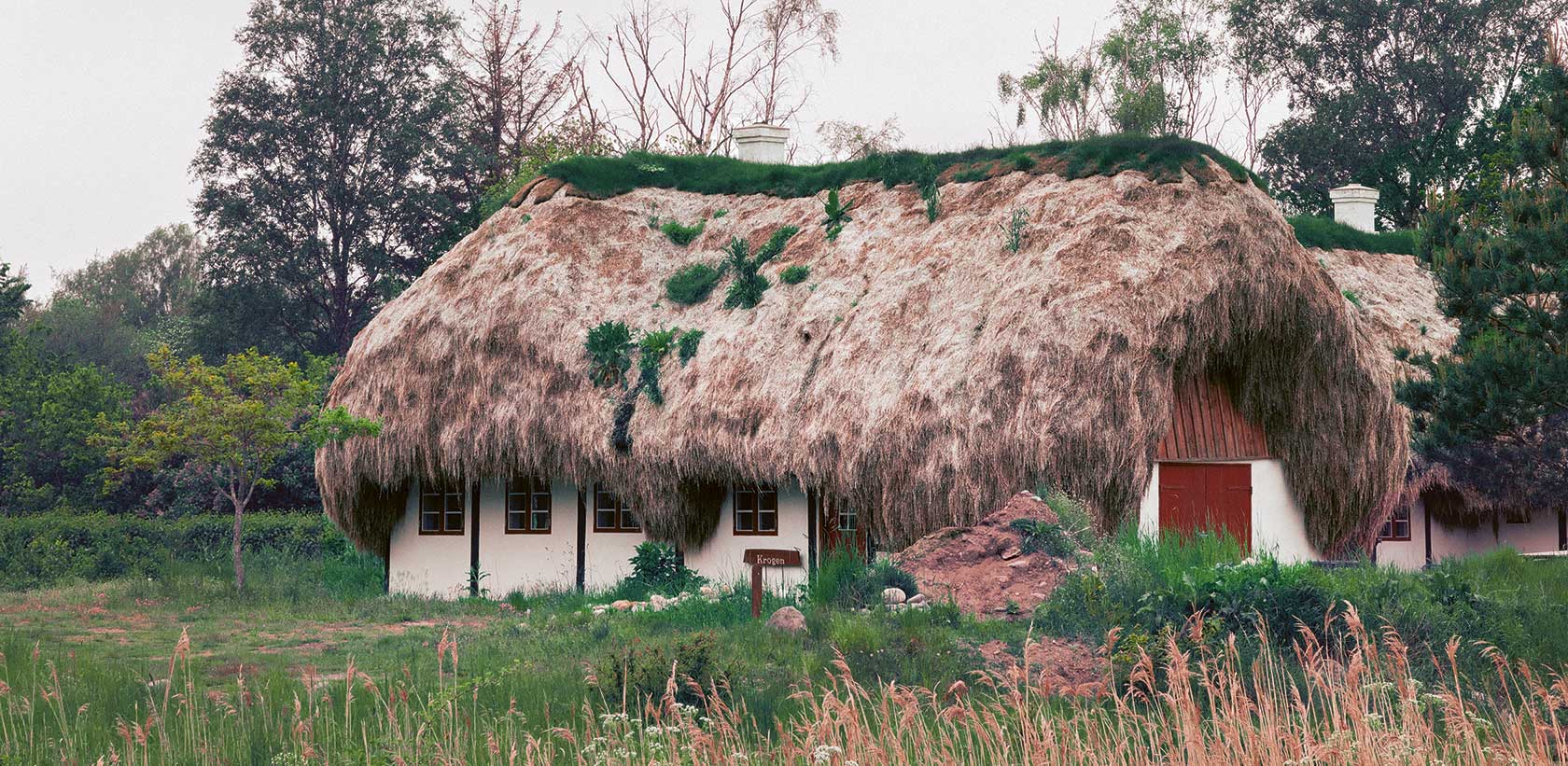
The name of the house, Knøv, is written on the gable beneath a pile of seagrass. Translated, it means something like “sweet little thing”. With a wave of her hand, the woman who lives here gestures for us to follow. She heads towards an extension ladder leaning against the house’s pitched roof. Beside it, her baby is sleeping in a pram, lulled by the rustle of seagrass blades. With practised ease, she climbs several metres up the shaking ladder, takes a long step onto the roof platform and pulls herself up onto the covering. Now she is sitting on the roof as if on horseback. “Come on!” she calls down, smiling. “There’s much more space up here than you’d think.”
Kirsten Lynge, casually dressed in a knitted jumper and loose trousers, has stood on seagrass roofs many times before. Today they can be found only here, on the Danish island of Læsø in the northern Kattegat, and on a peninsula in China. In her twenties, she helped her stepfather with roof thatching. Today she is 37, an entrepreneur, and wants to breathe new life into this ancient natural building material. Her start-up, Søuld, uses it to make acoustic panels that hang in restaurants, offices and hotels around the world, in Denmark as well as in countries like the United States and Japan. The products are available as wall and ceiling coverings or framed like works of art. The brown-beige natural fibres are always undyed and visible. Thanks to their porous structure, they absorb sound indoors and improve room climate, as they absorb moisture from the air and release it again. Conventional acoustic panels are made from energy-intensive materials such as mineral wool, and sometimes from wood or felt.
How it all began
Lynge has straightened up and is taking a few steps through the almost knee-high grass towards the chimney. Wind and birds have carried seeds onto Knøv’s roof, where they take root in the seagrass. Long peat mats lie across the ridge, protecting it from wind and weather like hair clips in a wild hairstyle. Lynge begins to talk about her home. Without Læsø, she would never have found her way to seagrass.
There were once 250 houses here with roofs like this; 31 remain today. The building method was most likely invented by women. More than 400 years ago, they came up with the idea of drying the seagrass washed ashore after autumn storms and spinning it into ropes, just as they did with wool. The ropes were tied around the wooden structures of the houses and sealed with 35 to 40 tonnes of loose bundles of seagrass. Up to 100 women and children would lay a roof in a single day, then celebrate. The salt-rich material from the sea and the way it was fastened gave the houses extraordinary insulation and made them resistant to fire and mould. Some have lasted for 300 years; a reed-thatched roof can last 50 at best. But over time, the tradition was set aside. For one thing, the sea no longer supplied enough raw material: much of the seagrass off Læsø died in the early 20th century because of high water temperatures and pathogens. For another, new industrial materials were imported, such as clay tiles and mineral wool, which were easier and cheaper to build with.
A baby’s cry interrupts the story. Lynge makes her way back down and lifts her seven-month-old daughter out of the pram, her second child with her husband. Together they live near Copenhagen, where her company is also based, and spend holidays at Knøv several times a year. Lynge grew up on the mainland, near Aalborg. When she was six, her parents separated. At eleven, she moved to Læsø because her mother had fallen in love again. Lynge did not mind the remoteness. Quite the opposite. “I felt much more at peace in the nature of Læsø.” She founded her first business in her twenties: an ice-cream parlour on her parents’ farm. Only local ingredients went into the cone: blackcurrants, apples, elderflowers and rosehips. “During the day I made ice cream; in the evenings I helped my stepfather with the roofs.” The farmer and reed thatcher Henning Johansen was often called in to replace old bundles of seagrass with reed. Reed was available in much larger quantities, and no one on the island knew how to make a seagrass roof any longer. Lynge remembers one moment particularly clearly, at an old guesthouse in the village of Byrum. “We sat there and thought: isn’t it absurd to replace this long-lasting material with something more short-lived?”
Johansen decided to relearn the old craft. While repairing seagrass roofs, he studied the old spinning technique used by the women; at home, he pored over historical accounts. In 2009, Johansen and Lynge joined forces with other islanders in the Tangbank project. They contacted foundations to raise capital for the restorations and built a supply chain for seagrass. A few years later, when Lynge was studying Sustainable Design Engineering in Copenhagen and engaging intensively with the transformation of the building sector, this became Søuld. The aim was to develop seagrass into a sustainable building material, for example for thermal insulation or soundproofing. During the restoration of houses, seagrass had also been found in walls. Lynge says that when you enter a building, you notice immediately that it absorbs noise. “There can be a terrible storm raging outside, but inside the house, it’s quiet. It feels like a warm embrace.”
Because two architects who specialised in sound absorption joined Søuld’s founding team, the decision fell on acoustic panels. And indeed, many of the products achieve the highest acoustic class in laboratory tests, just like standard synthetic products. Their fire-safety performance also comes close to that of competing products.
Lynge puts her baby into the car. They are heading to the farm, where the rest of the family is waiting. The drive from Knøv in the east to the farm in the west crosses the entire island, past lush forests and salt marshes. Peacocks and sheep cross the road as she turns into the car park. Henning Johansen, a pipe in the corner of his mouth, rattles past on a ride-on mower. Lynge waves her stepfather over; lunch is about to be served.
In the rustic dining room, home-baked bread is served with potato and egg salad, followed by pancakes with ice cream. Her four-year-old daughter says the farm is her very favourite place. Even if there were no ice cream? She hesitates for a long time. Lynge laughs. Johansen says he travelled to China to inspect the seagrass houses there. “I wanted to see for myself how the building methods differ.”
A future UNESCO World Heritage Site
The differences are central to the designation as UNESCO World Heritage, which could become a reality in a few year. Instead of looking like heavy, tousled wigs, the slender Chinese roofs appear as if drawn with a ruler. They are not made only of seagrass, but of a mixture including straw and clay.
After lunch, Lynge shows us samples of her acoustic panels. They smell faintly of salty sea breeze and straw. Unlike algae, which rot when washed up on the shore, seagrass has only a subtle scent. In the brownish products, that scent is trapped along with the carbon the marine plant absorbs as it grows. If the washed-up blades were not processed into building panels, but decomposed by microbes on the beach, the CO₂ they contain would be released. Because the amount of carbon stored in the seagrass is greater than the emissions from production, the products are CO₂-negative. The values range from -1.8 to -3.6 kilograms of CO₂ equivalents per square metre. By contrast, acoustic solutions made from stone wool or glass wool emit up to 4 kilograms of CO₂ during production, depending on efficiency and the energy mix.
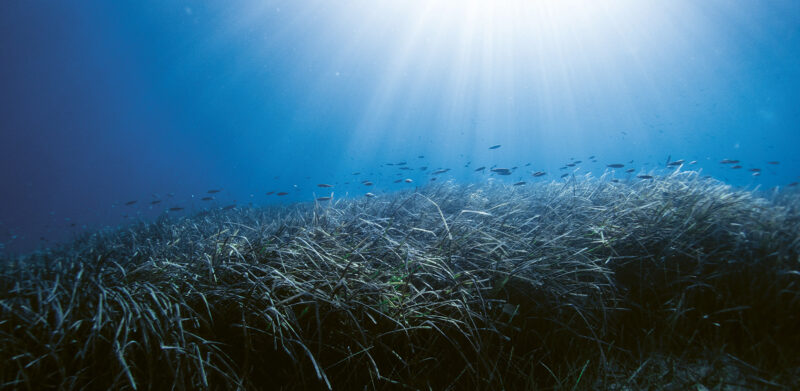
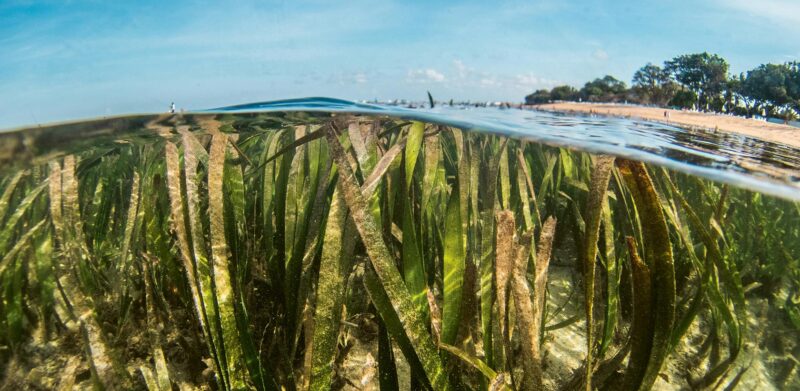
The raw material comes from southern Denmark, where it still washes ashore in large quantities. In autumn, the seagrass meadows in the sea shed their old blades, and the waves carry them onto land. Farmers collect them before they can mix with dirt and algae on the beach. Using a grab arm on a tractor, they fish the still-green blades out of the shallow water and spread them across their fields. Rain and sun clean and dry the blades, which are turned several times. Pressed into bales, they reach the factory in the north, where they are cleaned again, sorted and shredded. Then the fibres are mixed with a synthetic binder, heated and pressed into panels. “We couldn’t find a bio-based adhesive that would last as long as the seagrass itself,” says Lynge. Even so, the products can be kept in circulation. “We take back old products, shred the fibres and make new ones from them.” In early 2026, this earned the company Cradle to Cradle certification.
Søuld’s ecological standards and aesthetics, however, come at a price. Its customers include well-known names such as the Michelin-starred restaurant Noma in Copenhagen, the Marriott hotel chain, IKEA and the National Gallery of Denmark. The fact that Søuld has found its niche in designer acoustic panels rather than insulation materials (see text at bottom right) also has economic reasons. More money can be earned from high-quality panels than from simple insulation material that is stuffed or blown into cavities and façades. Alongside the time-consuming fieldwork, special machines had to be developed for processing the material in the factory. The nine-person team is not yet making a profit. Investment has come from a Danish sustainability consultancy and from the biotech entrepreneur and marine biologist Jacob Jelsing.
The sun is still burning in the blue sky; a Danish flag hangs limp, signalling a lull in the wind. Lynge walks beneath the white blossoms of apple trees towards a hut with a half-finished seagrass roof. Johansen and his apprentice Ida Svendsen began work on it a year ago. With two people, it simply does not go as quickly as it once did with a hundred. What is the house intended for? “We’ll see,” Lynge says calmly. Her reddish-brown hair is tied into a low bun; every now and then, a strand blows into her face. As she breastfeeds her baby and picks flowers for her to play with, she talks about her childhood.
Growing slowly, but properly
After her father disappeared to Greenland, her mother, then a nurse, had to support her three children on her own. Lynge’s favourite hobby was horse riding, but because money was tight, she was always given the wild horses. She grins. “The ones nobody else wanted to ride. I got really good at not being thrown off.” To learn how to make ice cream, she later took a course in Italy. To understand the seagrass craft, she followed her stepfather onto the roof. Lynge says she wants to do everything properly. That is why Søuld is growing only slowly. There are plenty of enquiries from manufacturers of other products: mattresses, car seats, shoes, furniture made from seagrass. “We have said no to many things because we want to focus on one market.” The material should also remain visible and tangible. “That way, we can tell its story better.”
Part of that story is that seagrass stocks are under threat, especially from the climate crisis and water pollution. For now, however, Kirsten Lynge is not worried about the supply of the raw material. The stretches of beach from which she obtains around 300 tonnes of seagrass blades each year are, taken together, less than three kilometres long. “And seagrass washes up all over the world,” albeit in different forms. On the Baltic Sea, carpets of common seagrass lie on the shore; in the Mediterranean, balls of Neptune grass roll across the beach.
If marine waste were to establish itself as a raw material, it would have positive effects: tourist beach communities would be rid of a waste problem, since they pay money for disposal. The construction industry, responsible globally for 37 per cent of emissions and 50 per cent of raw material consumption, could increase its share of renewable resources. But the forces of inertia are strong. After her studies, Lynge herself worked at a large engineering firm. There, the attitude was often “carry on as before” rather than “think further ahead”. Lynge preferred to create something new rather than simply continue what was already known. With Søuld, she has found a way to do both. A seagrass industry is meant to emerge so that the islanders “can hopefully still repair their roofs with this raw material in a hundred years’ time”. Translated, Søuld means “sea wool” – an allusion to the status quo, to mineral wool, and to the women’s craft inspired by wool spinning. If that craft lives on, it will be thanks not least to Lynge, Johansen and his new apprentice Ida Svendsen, a young woman from Læsø.
Building with Seagrass
Washed-up seagrass is well suited as a building material because it is resistant to moisture, mould, pests and fire. It also has a porous structure that can regulate humidity and absorb sound waves. For this reason, it can be used in acoustic panels, or for soundproofing and thermal insulation in building façades, roofs, ceilings and interior walls. In Germany, only a handful of companies, such as Build Blue and Seegrashandel, work with the material, and their market share is small. Overall, bio-based insulation materials—including seagrass, wood fibre, cellulose, hemp and flax—account for less than ten per cent of the German market.There are many obstacles: the costly building approval process, the powerful lobby for synthetic materials, the variable quality of natural materials and the higher prices resulting from small production volumes. Conventional insulation materials are made from rock wool and glass wool. These are produced by melting rock or recycled glass in extremely hot furnaces, processing it into fibres, and pressing it into batts. This consumes several times more energy than processing seagrass, which only needs to be cleaned, dried and shredded.
_________________
This text was translated by our partner kompreno — created with the support of various AI models, then reviewed and refined by their editorial team. kompreno curates the world’s best journalism from over 30 international outlets — including The Atlantic, Le Monde and Die Zeit — and makes it available in five languages.