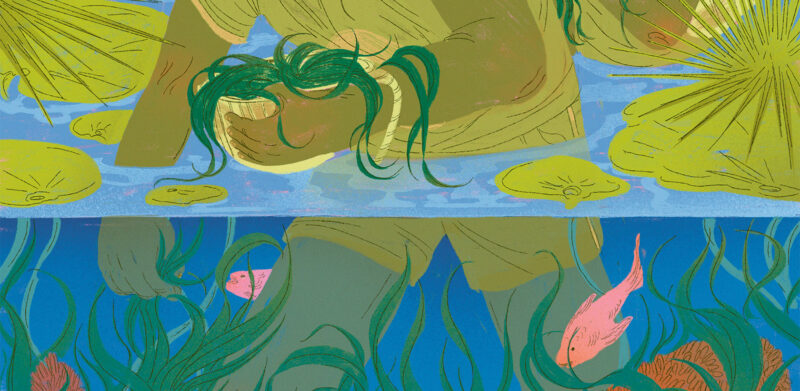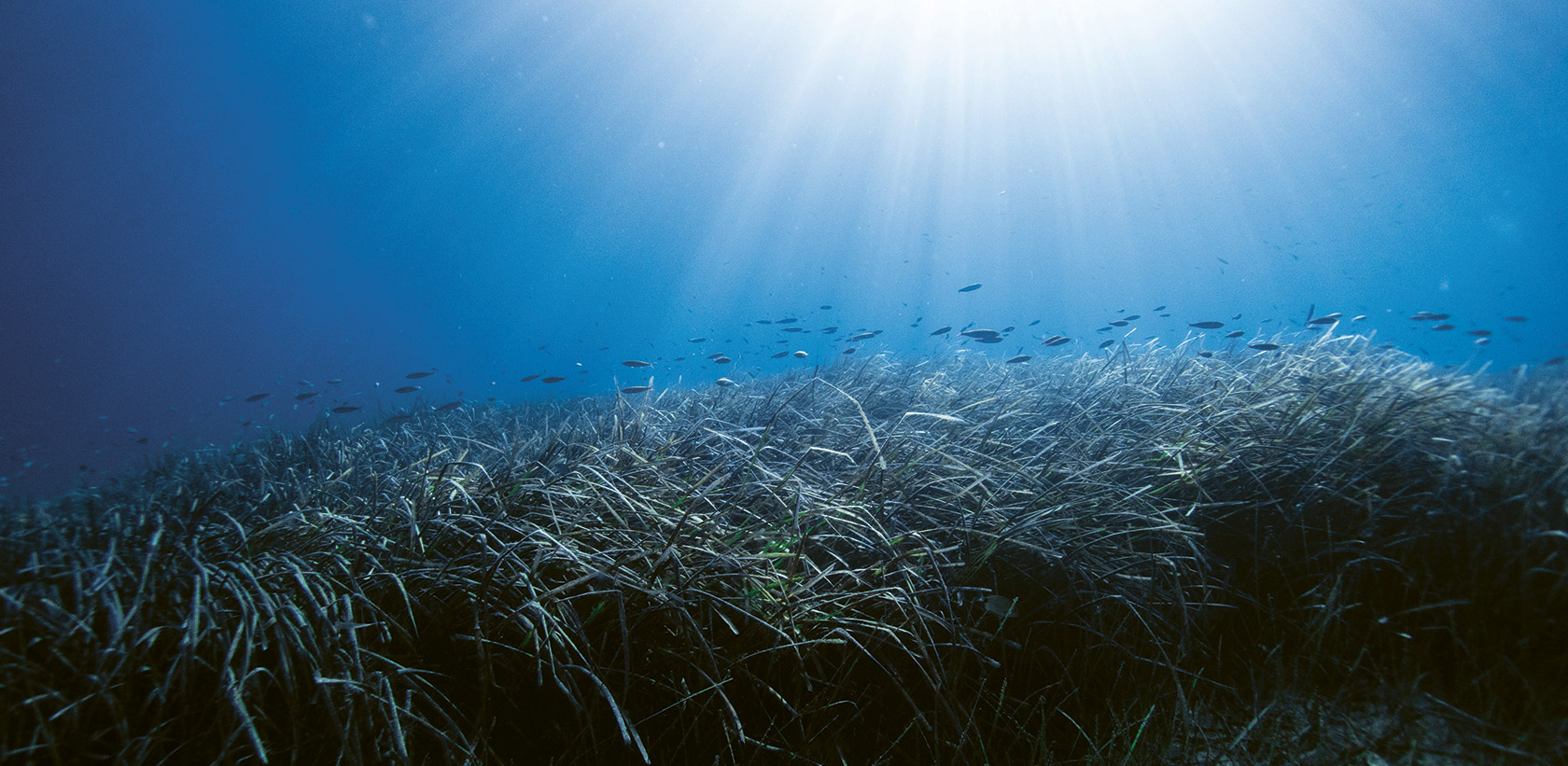
Slowly, the manatees glide through the underwater grass of the Caribbean. Like gentle marine vacuum cleaners, they graze on kilometre-long meadows, keeping the ecosystem in healthy balance. Sheltered by the blades, needlefish, seahorses and rays raise their young. In the underwater meadows of the Mediterranean, the shimmering egg cases of catsharks cling to the leaves of the seagrass until the young hatch. Small sea turtles hide from predators on the meadow floor, while cormorants find food in this fish-rich habitat. And further north, on the coasts of the North Sea and the Baltic Sea, herring attach their sticky spawn to the grass, while brent geese and wigeons feed on the greenery.
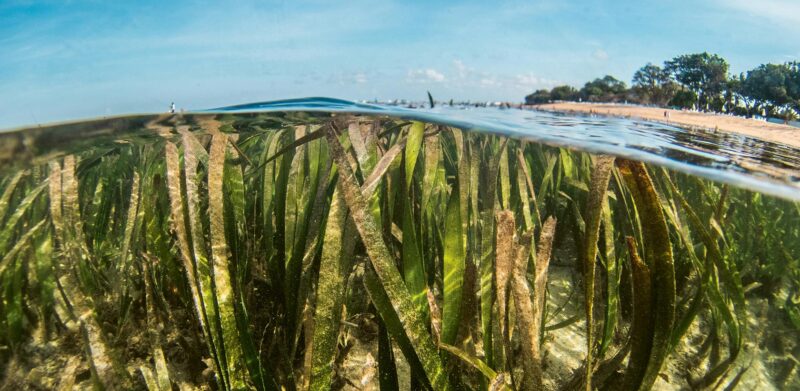
Seagrass meadows are the Serengeti of the seas – hotspots of biodiversity, habitats, nurseries and food sources for millions of species: marine mammals, fish, crustaceans, snails, mussels, worms, and microorganisms. Seagrass is found almost everywhere in the world, in more than 150 countries: from the Caribbean to the Balearic Islands, from Australia to Scotland, from the Indian Ocean to the Black Sea. It covers around 18 million hectares of seabed and thrives in shallow areas along coasts, at depths of one to almost 60 metres. The leaves of some varieties grow up to two metres long, swaying in the current like thick hair. Others grow in fine, short blades on the sand beneath the sea. There are around 70 species of seagrass on Earth. No one knows exactly how many.
But one thing is certain: seagrass is one of the most extraordinary organisms on Earth. It is the only true flowering plant in the sea. Despite often being mistaken for algae, seagrass is biologically related to them about as much as fungi are to daisies—that is, not at all. Like most other plants, seagrass once moved from the sea onto land. At some point, it found its way back to the sea, probably to escape the pressure of competition along the coasts. Seagrass now lives entirely underwater, wherever there is still enough light for photosynthesis. Its roots draw nutrients from the seabed; its leaves absorb carbon dioxide from the water and, with the help of sunlight and chlorophyll, convert it into sugar and oxygen. Like land plants, seagrass produces flowers and pollen; the sea takes care of pollination. Currents often carry the seeds hundreds of kilometres – an important mechanism for securing genetic diversity.
The largest plant on Earth
At the same time, seagrass reproduces itself through cloning. Its root system, which runs through the seabed like a net, forms underground offshoots known as rhizomes. New seagrass shoots keep growing upwards from them. The rhizomes can live for thousands of years. In 2022, researchers in Australia made a sensational discovery using genetic analysis: the largest plant on Earth is a seagrass meadow. It lives in Shark Bay and covers more than 180 square kilometres, the equivalent of around 28,000 football pitches.
And seagrass meadows are remarkably versatile. They store more CO2 than forests, and they do it faster. Depending on the species, they are so effective that they store 30 to 50 times more carbon per square metre underground than comparable forest-covered ecosystems on land. For centuries, they have trapped carbon into the mesh of their roots and rhizomes, sealing it in the sediment like in a preserving jar. Experts refer to them as “peatlands in the sea”. Their root networks also hold coastal sediments firmly in place, and the dense stands of some species can reduce the force of waves by up to 40 per cent. They form symbioses with numerous microorganisms, which act like a biofilter, cleansing the water of germs. Where seagrass thrives, the sea is clear, clean and rich in oxygen.
And yet, over the past hundred years, an estimated 30 per cent of the world’s seagrass meadows have been destroyed. Some experts put the figure as high as 60 per cent.
There are many reasons for this. Fertilisers from agriculture, washed by rivers into the sea, fuel algal growth and suffocate the grass. Some algae darken the water so much that the seagrass lacks the light it needs for photosynthesis. Others attach themselves to its leaves and block the chlorophyll’s path to converting sunlight into chemical energy. Rising water temperatures further accelerate algal growth. As with corals, too much heat and too many nutrients can cause “white plaque” to form on the leaves: a biofilm of microorganisms or bacteria that can be harmful.
Urbanisation along the coasts also threatens the habitat of seagrass meadows. More cities mean more wastewater, more ports, more infrastructure in shallow seas: cable routes, pipelines, offshore structures and bridge piers. Where trawling and boat traffic are booming, seagrass meadows suffer. Nets rip the grass from the seabed in clumps; anchors and their chains carve deep furrows into the green carpets on the seabed. All this is fuelled by tourism worldwide, which continues to drive recreational boating and coastal construction.
A secret weapon against the climate crisis
According to the United Nations Environment Programme (UNEP), seagrass meadows are now among the most threatened and, at the same time, least noticed ecosystems on Earth. Yet UNEP describes them as one of the “secret weapons” in the fight against the climate crisis: although seagrass covers only around 0.2 per cent of the seabed, it is responsible for ten per cent of the oceans’ carbon storage capacity.
So what? For a long time, these silent climate protectors in the sea were met with little more than a shrug. Attention turned instead to land: forests, wetlands and, increasingly, peatlands. Perhaps this is because the underwater world is less accessible to humans, suspects the Australian biologist and palaeoecologist Nicole Foster, who researches the use of marine habitats in Blanes in southern Spain (see p. 58). Perhaps it also has to do with the fact that, at least in Western culture, the underwater world is bound up not only with longing and fascination, but often with fear.
Lost knowledge
In Greek mythology, the island kingdom of Atlantis sinks into the sea; in Nordic sagas, undead sailors, draugr, roam the coasts covered in seagrass. People in northern Europe and around the Mediterranean once used seagrass seeds as food and the leaves as bedding for livestock. But much knowledge was lost with industrialisation. Indigenous communities in Mexico, India and Australia have preserved it (see p. 28).
Yet awareness of the value of natural climate protectors is slowly growing everywhere. Increasingly, attention is turning underwater too, above all in science. Oceanographers, biologists and geologists are gaining new insights into the complex ecosystem of underwater meadows: into their biodiversity, which is often even greater than assumed (in Scotland, more than 50 fish species were recently found in a single meadow); into the diversity of seagrass species worldwide (on the east coast of China, researchers at the Geomar Helmholtz Centre for Ocean Research in Kiel recently discovered a new miniature species through genetic analysis); into its antibacterial effects, which may one day be used for a new kind of antibiotic (see p. 54); and into the possibilities of using nutrient-rich seagrass seeds as food (see p. 58). Yet many questions remain open. In which regions does seagrass bind the most CO2? What does this depend on? How much does it store permanently? Does this vary, and why?
How old is a meadow, really?
To answer such questions, researchers are once again heading out on expeditions during these summer months. In Europe, now is the right time: the seagrass is in bloom. One of them is Thorsten Reusch, Professor of Marine Ecology at Geomar. On 9 July, the research vessel Malizia will set sail for the Baltic Sea. “There is still so much we want to know,” says Reusch. How old, for example, is a seagrass meadow exactly? Samples are expected to provide clues using a new method: the molecular clock. It compares gene sequences and reveals random mutations in DNA that accumulate over time at a steady, clock-like rate. The number of mutations gives clues about the age. Another innovation is eDNA scanning. Water samples are searched for snippets of genetic material that plants and animals have shed into the water, in skin flakes or rubbed-off leaf fibres. Reusch says: “This way, we learn more about the biodiversity hidden deep inside the meadows.” The scientist is also taking on a research question on behalf of policymakers: where are the blue-carbon hotspots in the sea that store particularly large amounts of CO2 and should therefore be placed under special protection?
In many countries, including Germany, seagrass is protected by nature conservation law. Here, as biotopes, the meadows are covered by the Federal Nature Conservation Act and fall under the EU Habitats Directive. If, however, a bridge is built, a pipeline laid or a tunnel dug, the seagrass has to make way, as is currently happening with the railway tunnel between the island of Fehmarn and the mainland. “Until a few years ago, those responsible would still have shaken their heads,” says Geomar researcher Reusch. “Now we were involved from the start: how can the gaps in the grass be closed again?” The growing awareness of the importance of seagrass is also reflected in laws and regulations. Under the Baltic Sea Protection Action Plan, agriculture must reduce fertilisers such as nitrate and phosphate, which can enter the Baltic Sea, by more than 2,000 tonnes per year by 2030; in the Balearic Islands, anchoring in seagrass has been banned since 2018 (see p. 18).
Replanting? Tricky
And in many countries, funding is being allocated to advance research and reintroduction efforts. The German government, for example, is providing six million euros for the SeaStore project to restore seagrass meadows. Because, as so often in climate protection, time is running out. Once seagrass is gone, it does not come back quickly. And when meadows are destroyed, tonnes of CO2 that had been locked in the soil for centuries escape into the atmosphere. But replanting damaged or destroyed seagrass meadows is extremely difficult (see p. 42).
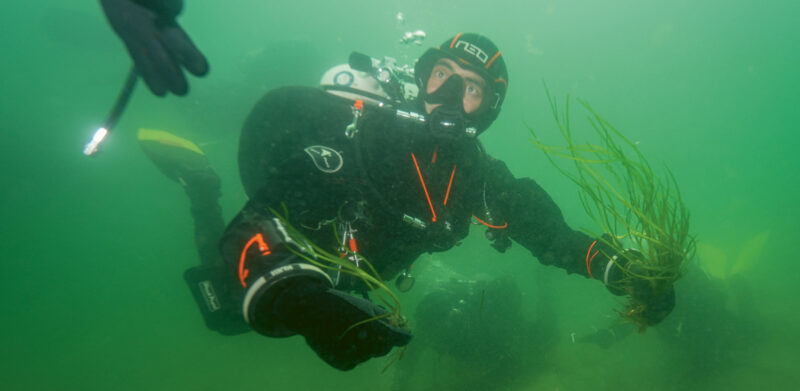
One thing is clear: the fight for seagrass can only be won together. International networks such as Seagrass-watch.org have been founded to monitor stocks and exchange experiences. NGOs such as WWF are equipping fishers in the Caribbean with AI-controlled underwater cameras that scan the seabed for seagrass. Volunteer divers, such as members of the Seagrass Conservation association from Berkenthin near Lübeck, plant seagrass blade by blade underwater and collect data from the meadows (see p. 42). Media outlets are taking up the topic, from Arte to ZDF, and a film by Swiss documentary filmmaker Sabrina Inderbitzi will be released in September. Even a children’s book about the realm of the underwater meadows has been published, written by a biologist; it has just been translated into Swahili (see p. 63).
Working on technical solutions
And all over the world, from the Netherlands to Australia to Scotland, people are refining technical solutions to make replanting easier. Which of them will work remains to be seen.
There are start-ups such as Zostera, which has developed a turf-roll-style planting method for companies that lay submarine cables and pipelines in shallow water and then have to restore damaged meadows. In such cases, working with divers around safety-critical technical structures is difficult: the risk of damaging cables is too high, and liability concerns are significant if anything goes wrong. Zostera therefore anchors seedlings to textile growing carriers on mats made from washed-up seagrass. A smart laying machine places them in the seabed beside the cables, allowing the seagrass to root through them into the sediment.
There are student initiatives such as Seeds, supported by the NGO Enactus, which aims to harvest seagrass seeds mechanically. An AI-controlled marine vacuum cleaner with teeth like a comb is designed to hover above the meadows in the water and gently pull the seeds from the shoots. The first prototypes are currently in testing. The aim is to offer the robots for lease worldwide. The spin-off is planned for 2027.
Others are looking for ways to use seagrass commercially. When the plant sheds its leaves in autumn, they line the beaches. For tourism, it is nothing but marine litter that drives visitors away; for entrepreneurs, it is a new raw material. Seagrass does not go mouldy, does not burn, does not smell and insulates well. It is ideal for thermal insulation, which start-ups such as Build Blue are developing, and exceptionally well suited for acoustic insulation in buildings, which engineer Kirsten Lynge offers in Denmark through her company Søuld (see p. 48).
Monika Meier knows how difficult it is to persevere in niches like these. Her company NeptuTherm is a pioneer in insulation made from Neptune grass fibres, which are washed ashore in the Mediterranean in autumn, shaped by the waves into small balls. Her husband Richard Meier, an architect and professor at Heidelberg University of Applied Sciences, founded the company in 2010. When he died in 2016, his wife and son took over. “We received awards and insulated schools and administrative buildings commissioned by the city of Karlsruhe,” says Meier. That lasted until 2020, when a storm destroyed parts of the storage facilities, the pandemic made work more difficult and problems accumulated. There were unreliable material deliveries and issues with the disposal of old insulation materials made of polystyrene and glass wool, which had to be removed from many public buildings before they could be replaced with seagrass insulation. Meier looked for investors; many waved her off. “Large companies need to be much more willing to experiment,” says Meier. “And there needs to be more support from the public sector, from foundations. Wood has a lobby; seagrass does not.”
Nardine Stybel is doing everything she can to build support. She is chair of the association EUCC – The Coastal Union Germany in Warnemünde, and through campaigns, education, and information on seagrass meadows she is working to increase acceptance of seagrass in local communities. “Many stakeholders know very little about this ecosystem.” For Stybel, one focus is tourism, which is the biggest obstacle to protecting seagrass meadows in the region. Recently she conducted a survey among tourists: what do you think of seagrass? The result was much better than expected. “When it lies at the water’s edge as a slippery mass mixed with algae, it does put people off going into the sea,” says Stybel. “But if it accumulates further up the beach when it is dry, most people say: it doesn’t bother me, you can just walk around it.”
Much is possible, and solutions are in sight. In this special issue, we set out to explore them – in research, in business, NGOs, gastronomy, and on the Balearic Islands. So that seagrass meadows can bloom again.
_______________
This text was translated by our partner kompreno — created with the support of various AI models, then reviewed and refined by their editorial team. kompreno curates the world’s best journalism from over 30 international outlets — including The Atlantic, Le Monde and Die Zeit — and makes it available in five languages.