Good Impact: Ms Tasdemir, many people see seagrass as annoying “underwater weeds”. Why is it actually so important?
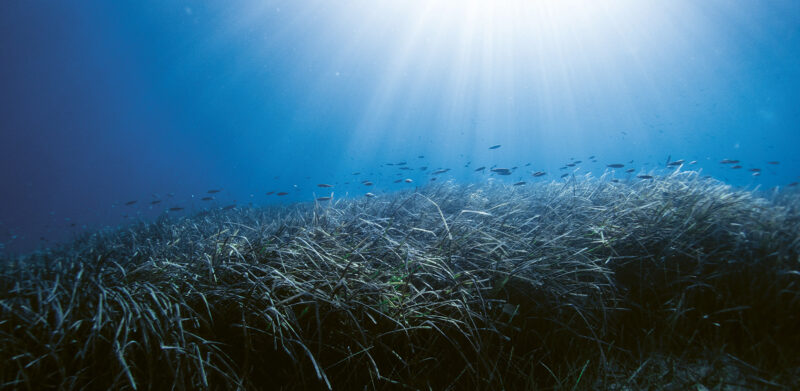
Deniz Tasdemir: It really is a major misconception. Many people find seagrass annoying, especially when they are swimming. To be honest, I used to feel the same way. Today we know that seagrasses are not weeds at all, but treasures for the oceans and for us humans. They purify water, store enormous amounts of CO2, produce oxygen and provide habitat for countless animals. That is why we call them the “lungs of the seas” or the “Amazon of the oceans”. Fortunately, public awareness of their importance is now growing.
GI: How did you personally come to work on seagrass, given that for a long time you saw it mostly as a nuisance?
DT: I trained as a pharmacist and initially specialised in the chemistry of land plants. Towards the end of my doctorate, I fell in love with marine organisms and, for a while, was almost obsessed with sea sponges. Later, I turned to marine plants — and seagrasses immediately caught my interest. They are the only true plants with roots and flowers that live entirely in the sea. Their ancestors once moved from the sea onto land, then later returned to the sea again. They therefore had to adapt several times to completely new environmental conditions, such as salinity. They gained new genes for various functions while at the same time losing many others.
GI: And how did the idea come about that seagrass might have antibiotic properties?
DT: The starting point was a 2017 study by a research group at Cornell University. The researchers examined polluted coastal waters in Indonesia, where there are hardly any functioning sewage systems. They compared water samples from seagrass meadows with samples from neighbouring sandy areas without seagrass. The result was remarkable: where seagrass grew, they found around 50 to 65 per cent fewer pathogens in the seawater. This applied both to pathogens affecting humans and to those affecting fish or corals. (Editor’s note: Pathogens are microorganisms or particles that cause infections and diseases in humans, animals or plants.) Similar effects were later observed in the Mediterranean, the South China Sea and here in the Baltic Sea. The pattern was the same everywhere: wherever seagrass was present, the surrounding water was noticeably cleaner. As a chemist, I immediately wondered what biological or chemical mechanism might be behind this.
GI: And what could that mechanism be?
DT: For one thing, seagrass meadows slow down the movement of water. This traps particles that pathogens cling to and causes them to settle more quickly in the sediment. Seagrass can reduce flow velocity and marine currents by up to 40 per cent, and it also dampens waves. That reduces the spread of pollutants.
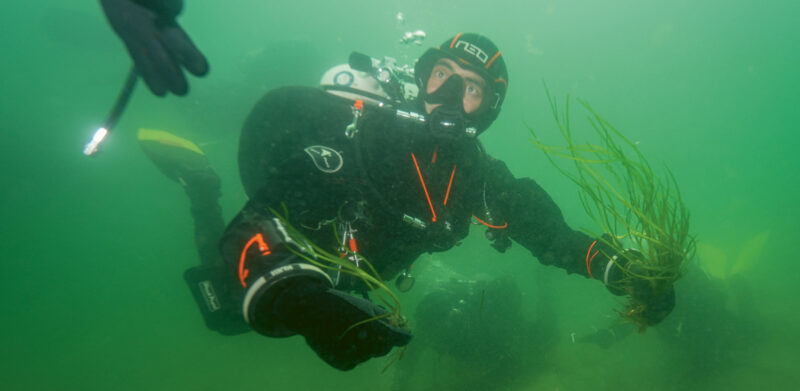
For another, we suspected a chemical mechanism. We asked ourselves: can seagrasses, or its microbiome, produce and release substances that inhibit pathogens in the surrounding seawater? So the first step is to examine the seagrass microbiome. Every biological surface in nature is colonised by microorganisms — including the human body. Billions of bacteria and fungi live on our skin and in our gut. Without this microbiome, we could not survive. The same applies to seagrass. We isolated hundreds of microorganisms from the surfaces and tissues of common eelgrass in the Baltic Sea …
GI: … and then analysed them?
DT: Exactly. We tested whether these microbes could kill pathogens — for example, waterborne bacteria such as Vibrio, as well as human, fish or coral pathogens. The results were astonishing: in laboratory tests, some of the isolated microorganisms proved significantly more effective than commercial antibiotics — in some cases three to four times stronger. And these were not even purified active substances, only crude extracts from these microorganisms.
Our chemical analyses have also shown that these organisms may contain numerous previously unknown antibiotic substances. The microorganisms on the seagrass surface were also significantly more effective than those from inside the plant. That makes biological sense: their role is presumably to protect the plant against harmful germs.
DENIZ TASDEMIR
… is a pharmaceutical scientist and an expert in natural product chemistry and biotechnology. She leads the Marine Natural Product Chemistry research group and is Director of the Centre for Marine Biotechnology at GEOMAR Helmholtz Centre for Ocean Research Kiel. Her work focuses on discovering new active compounds from the sea for use in human medicine, as well as applications for aquaculture and agriculture.
GI: Does seagrass itself also produce antibacterial substances?
DT: Yes. In summer, when the water warms up, many pathogens multiply much faster — including faecal and Vibrio bacteria that can be dangerous to humans. We took water samples in the Baltic Sea at many different sites and at different times of year, both directly above seagrass meadows and at neighbouring control sites without seagrass. We were able to show that the water above seagrass meadows contains particularly high amounts of natural molecules known as flavonoids. These plant substances are well known for their antibiotic properties. We found exceptionally high concentrations of these flavonoids especially in the summer months. Which means: the higher the pathogen load in the water, the stronger the seagrass’s chemical defence response.
GI: What makes these Vibrio bacteria so dangerous?
DT: Vibrio bacteria are part of the natural microbiome of many marine areas. However, rising sea temperatures cause them to multiply very rapidly in summer, especially in the low-salinity Baltic Sea. For healthy people, that is often not a problem. It becomes dangerous above all for older or immunocompromised people. If people with open wounds go into contaminated water or swallow seawater, these bacteria can enter the body and cause serious infections that can even be fatal. That is why monitoring systems for Vibrio levels are now in place in many regions. Seagrass meadows could play an important role here in protecting public health.
GI: Resistance to common antibiotics is increasing, and alternatives are urgently needed. Could we develop medicines from the antibiotic substances found in seagrass meadows?
DT: Absolutely. The overwhelming majority of all antibiotics originally come from natural microorganisms. Penicillin, for example, was derived from a mould. So far, however, there has been very little research into active substances from the sea, mainly because of a lack of funding. We also face another problem: over the past few decades, the pharmaceutical industry has increasingly withdrawn from antibiotic research. Developing new antibiotics is expensive, time-consuming, risky and often less economically attractive than, say, developing cancer drugs.
GI: When might there be the first prototype of a seagrass antibiotic?
DT: Our research is extremely complex and time-intensive. First, we have to identify the most promising microorganisms with strong antimicrobial activity. Then we analyse their entire chemical composition to find out which substances might be responsible for the observed antibiotic effect.
After that, we have to isolate these molecules, understand their mechanism of action and, finally, test whether they are effective and safe for humans. This process often takes many years. Of course, we hope that in the long term this could lead to new medicines — both for humans and, for example, for aquaculture.
GI: Why aquaculture in particular?
DT: In aquaculture, enormous quantities of antibiotics are used to prevent disease in densely stocked facilities. This in turn contributes to the development of resistance and puts a strain on the environment. That is why it would be interesting to investigate whether seagrass, or substances derived from it, could be used to reduce pathogens in fish farms in a natural way.
Some studies already show that mussel and fish farms near seagrass meadows have significantly fewer pathogens. That is why we urgently need more research and much better funding for this exciting field. Seagrass meadows have long been neglected. That has to change.
___________________
This text was translated by our partner kompreno — created with the support of various AI models, then reviewed and refined by their editorial team. kompreno curates the world’s best journalism from over 30 international outlets — including The Atlantic, Le Monde and Die Zeit — and makes it available in five languages.